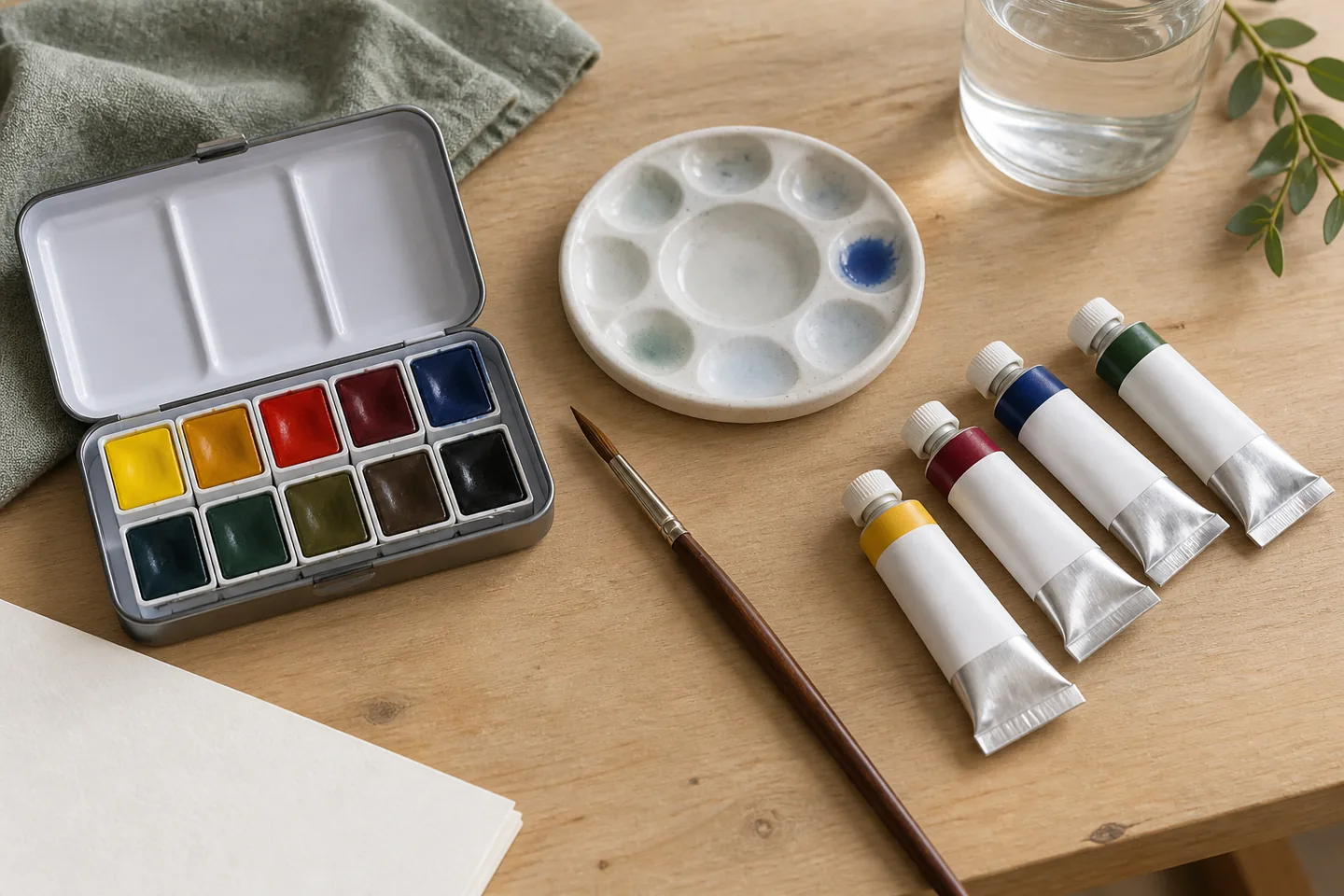
Choose watercolor pans or tubes for the way you set up and load paint, rather than treating the container as a quality grade. Pans are convenient for a compact, ready-to-open arrangement. Tubes let you dispense paint into a separate mixing area. Neither format is automatically better for every artist or cheaper for every routine.

Start with the painting session you want
| Your priority | Try first | Question to ask |
|---|---|---|
| A compact arrangement you can open and use | Pans in a fitted box | Does it provide enough mixing space for your exercise? |
| Preparing a larger pool of a color | Tube paint and a palette | Can you dispense and mix a useful amount without crowding the palette? |
| Replacing one frequently used color | A refill in the format your range supports | Is the matching color available, and does the container fit? |
| Learning with materials you already own | Your existing set | What specific problem would a new format solve? |
This is a suggested way to decide. Your brush, palette and working space belong in the comparison alongside the paint.
Does tube paint have better color?
Not simply because it is in a tube. In its Tubes vs. Pans FAQ, Schmincke says HORADAM AQUARELL Series 14 uses the same pigmentation for both formats and does not describe a color or quality difference between them. That is a statement about that range, not proof of identical formulas across the entire market.
If you compare a student pan set with another manufacturer’s artist-grade tubes, you have changed both the product and format. Any difference you observe cannot be assigned to the container alone. Keep the brand, range and color identification in your notes.
Can you put tube watercolor into an empty pan?
Check your maker’s guidance. Schmincke describes filling its pans with liquid watercolor and drying them; it also explains that dried and liquid volumes are not directly comparable. Do not turn a container capacity into a universal refill formula.
If your range supports the approach, try one color in a clean, labeled pan before transferring a whole set. Follow its drying and storage instructions. Record the color name and product range on the pan or your palette map, so that a later refill is identifiable. This article does not prescribe homemade additives or a single drying time for every paint.
Already have paint that has dried in a well? Follow the guide to rewetting dried watercolor to separate reusable palette paint from a solidified tube before buying replacements.
Compare costs using your own shopping list
Make two short lists for the same planned session. Include the selected colors, a usable mixing area and any empty containers required. Compare the total outlay before trying to estimate a cost per painting.
For two tubes, price per labeled milliliter can compare package prices within the same color and range. It does not automatically compare a dry pan with a liquid tube, nor predict how much paint you will use. A larger pack that you seldom reach for can still be the wrong purchase for your routine.
A small trial before changing your setup
Pick a familiar color and a modest exercise. Note how you loaded the brush, where you mixed the wash and whether the arrangement gave you enough working room. Assess the process as well as the result. If you like your current paint but need more mixing space, changing the palette may answer the problem without replacing the paint set.
For a different question about paint type, see gouache vs watercolor. After the session, follow the brush-cleaning routine.
Source checked September 9, 2026. Research-based format guide with original decision aids. No paint-quality or value-for-money test was performed.