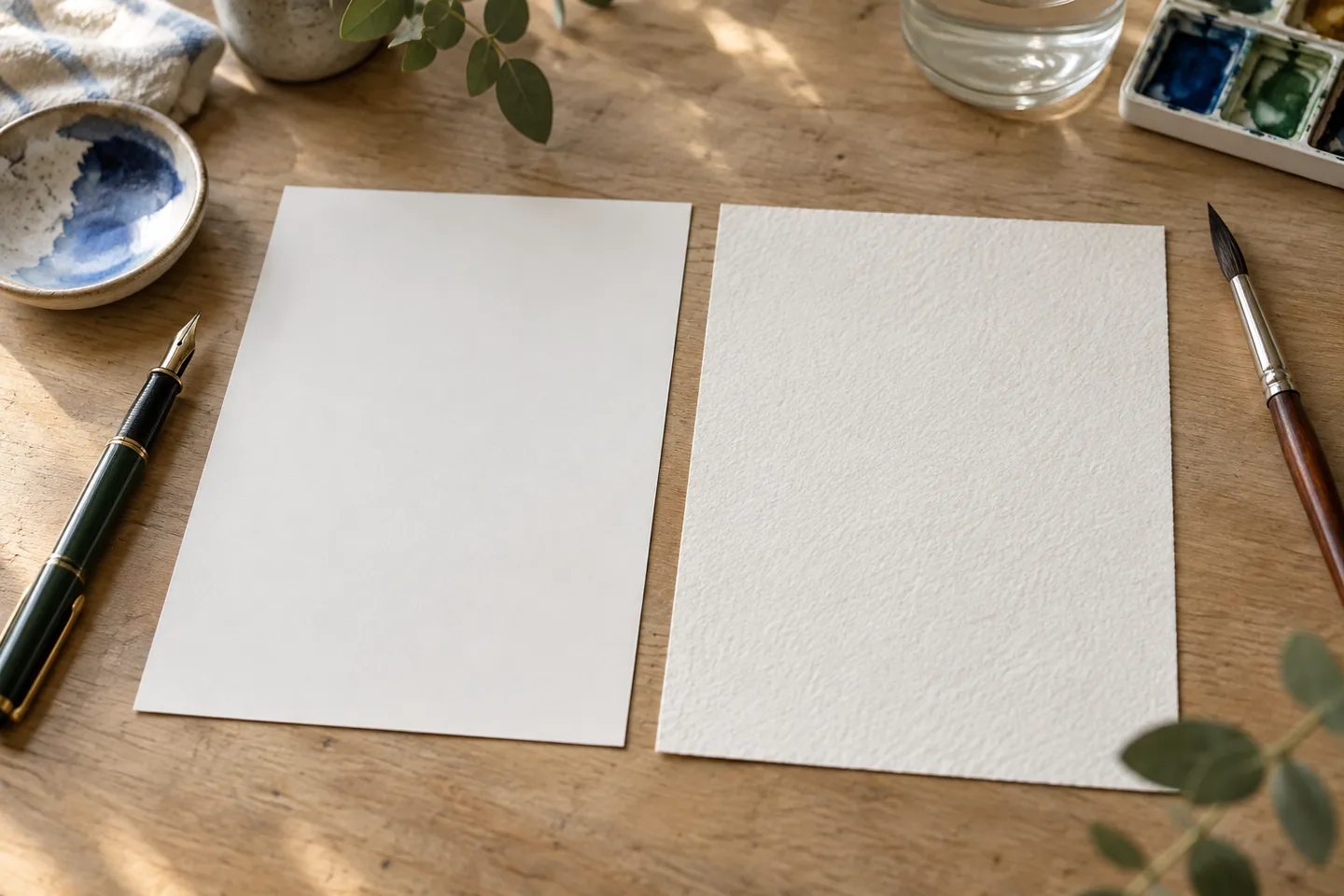
Hot press watercolor paper has a smoother surface; cold press has more surface texture. Start with hot press when fine lines are your priority, and try cold press when you want a more textured surface. Neither is a skill level you need to graduate to: choose for the marks you want to make.


Hot press vs cold press: the practical difference
Winsor & Newton describes hot press as the smoothest of its watercolor paper surfaces and connects it with detailed illustration. It describes cold press as more textured, with a surface suited to visible texture and granulation. These descriptions are useful starting points, not a promise that every paint will behave identically on every brand of paper.
| Your priority | First sample to try | What to check yourself |
|---|---|---|
| Small lines and carefully drawn detail | Hot press | Whether your usual pen, pencil or fine brush gives you the line you want |
| A visible paper texture in your painting | Cold press | How much texture remains visible in a light wash and a dry brush mark |
| Exploring granulating paint | Cold press | Whether the effect suits your particular paint and way of applying it |
| Learning which surface you enjoy | One small sample of each | Which makes your chosen exercise easier to repeat |
Use this table to decide what to sample first. It does not rank one surface as universally better, and it does not replace checking the description of the specific paper you plan to buy.
A concrete product-range example
ARCHES Aquarelle is one useful label-reading example because the maker lists 300 gsm hot pressed, cold pressed and rough sheets in the same range. Its 56 × 76 cm natural-white sheets are listed in both hot press and cold press at 300 gsm. That lets you hold range, stated composition, color, size and weight constant on paper while changing the stated texture. It still does not predict how your own paint and technique will look, so buy samples rather than treating the specification as a finished result.
Which surface should you try?
If your work starts with a detailed drawing
Try a small sheet of hot press. Make a few lines with the actual tool you will use, including a slow curve and a short hatch pattern. Then add the type of wash you intend to paint. Judge the combined result; a surface you like for drawing may still deserve a separate painting trial.
If the surface is part of the look you want
Try cold press and leave a section of the sheet lightly painted so you can see how the paper contributes to the finished image. Use a familiar paint before changing several materials at once. If you are also trying a new pigment or brush, label those changes so you do not attribute every difference to the paper.
If you are buying your first watercolor paper
Choose a manageable sample or small pad with its surface and weight clearly labeled. Pick one exercise you actually want to learn, then decide whether the result and the price work for you. A beginner does not need to own every surface to start, and an experienced painter can still prefer the same surface for years.
Surface and weight answer different questions
Hot press and cold press describe the surface choice. A number such as 300 gsm describes mass per unit area. Canson distinguishes paper weight in grams per square meter from thickness, which is measured separately. Do not read a higher gsm number as a guarantee of a smoother surface or a specific thickness.
If the weight label is confusing, read what 300 gsm means for watercolor paper before comparing packs.
Compare two samples without changing everything else
This is a suggested exercise you can run yourself. We have not performed or photographed a controlled comparison for this guide.
- Label both samples. Record the brand, range, surface and gsm. If they differ in other specifications, keep those differences in your notes.
- Choose three marks. For example, draw a fine line, paint a small wash and make a dry brush stroke. Use the same tools and paint for both samples.
- Keep the exercise comparable. Use similarly sized areas and the same support. Record any change in water amount or technique rather than assuming it had no effect.
- Look again when dry. Note the line edges, visible surface texture and which marks you would like to make again.
- Choose for your next project. Write one sentence explaining your preference. Keep the samples so that a later purchase is based on your own reference.
Use the free printable paper comparison sheet to keep the labels and observations together.
Common questions
Is hot press only for advanced painters?
No. The surface label is not an experience rating. For a beginner, the useful question is whether the paper helps with the marks and exercise they want to practice.
Is cold press the same as rough paper?
Do not assume that the names are interchangeable. Canson describes a fine-grain surface between smooth satin and rough grain. Check the surface options within the particular manufacturer’s range before treating two differently labeled papers as equivalent.
Will choosing a surface stop my paper from buckling?
No. Surface preference is not a test of how a particular sheet behaves when wet. Keep the paper’s weight, format and preparation instructions in your purchasing notes, try your normal painting process on a sample, and use the buckling guide if movement is the main problem.
Sources and scope
- Winsor & Newton: Difference between hot and cold press watercolour paper — manufacturer guidance on surface and intended effects.
- Canson: Selecting your watercolor paper — distinctions between surface, weight and thickness.
Sources checked September 11, 2026. This is a research-based guide with an original practice exercise and a generated editorial illustration. It includes no product testing, product ranking or sponsored recommendation. See how these guides are made.